Common names
Blind salmon, Blink tassel-fish, Burnett salmon, Gold threadfin, King salmon, Kingfish, Sheridan threadfin, Triped tassel fish, Threadfin salmon
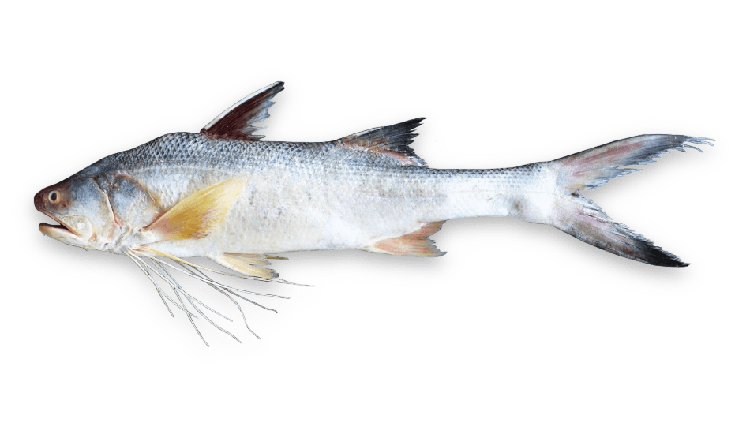
Polydactylus macrochir
Blind salmon, Blink tassel-fish, Burnett salmon, Gold threadfin, King salmon, Kingfish, Sheridan threadfin, Triped tassel fish, Threadfin salmon
King threadfin have a pointed snout and the dorsal profile of the head is almost flat in young fish and concave in adults. There are two separate dorsal fins, the first dorsal fin has 8 spines and the second spine is thicker than others. There are 5 pectoral filaments with the first filament being the shortest, reaching past the level of origin of the pelvic fin. The caudal fin is deeply forked with neither of its lobes being filamentous. Their lateral line is simple in form and extends from the upper end of the gill slit to the upper end of the lower caudal fin lobe. The upper sides of the head and the flanks are tinged golden silver, becoming silvery on the lower flanks. Both dorsal fins are pale brown, the pectoral and pelvic fins are vivid yellow. The front portion of the anal fin is yellow, the remainder being yellowish-white. The pectoral filaments are white or yellowish-white. The tail is greyish with a greyish-black rear margin.
They occur in shallow, turbid waters such as coastal waters, estuaries, mangrove creeks, and mangrove-lined rivers, over sandbanks and mud substrates. They normally aggregate into loose schools, however, the larger individuals are more frequently recorded as pairs or as individuals.
Found in the eastern Indian Ocean and the western Pacific Ocean. It is found in southern New Guinea and northern Australia. In Australia its range extends from Eighty Mile Beach in Western Australia to the Brisbane River in Queensland. In New Guinea its range extends along the southern coast from Western New Guinea, Indonesia, to the Gulf of Papua in Papua New Guinea.
They are a carnivorous species which feeds on prawns and fish. Appear to be transitional hermaphrodites in that they have mature male and immature female reproductive organs, and they function reproductively as males. King threadfins in the process of transitioning are most frequently recorded from June to September. The females spawn pelagic eggs but little is known about the larvae although the nursery areas are inshore, shallow and of low salinity.
Threadfin salmons are excellent eating when cooked in a wide variety of ways. Their firm flesh and large flakes make them ideal for barbecuing or grilling in steaks, cutlets or fillets, depending on size and variety. Threadfin fish are high in many important nutrients, including high-quality protein, iodine, and various vitamins and minerals.
Favourite lures for threadfin salmon are soft plastics (soft vibes), sinking stick baits, hard vibes and small shallow diving hard bodies. Good bait: pilchards and mullet (live or freshly cut), or prawns.
Blue threadfin - Features that distinguish king threadfin from blue threadfin: Five pectoral filaments extending almost to the anal fin